Why Every Small Business Needs a Data Layer Before AI Can Help Them
Most AI tools fail small businesses not because the models are weak — but because the business has nothing structured for the model to reason about.
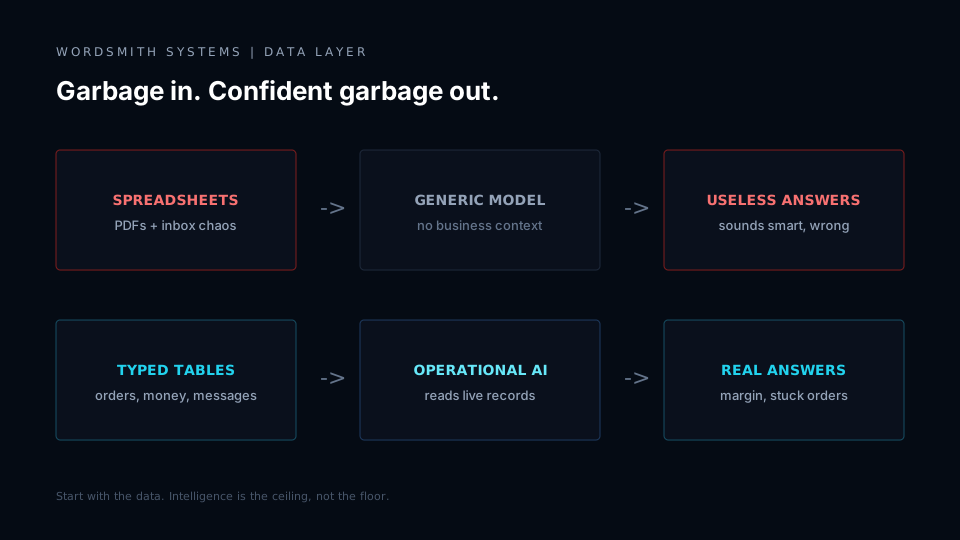
Before a language model can answer "what did we net last month?" it needs orders in typed tables, customers in a real database, inventory tracked, payments timestamped, and messages attached to threads — not trapped in PDFs and chat scrollback.
That foundation is the data layer. It sounds boring. It is the highest-leverage work you can fund.
Tool uptake is not readiness:
ChatGPT can draft an email. A plug-in can summarize a CSV export. Vendors will sell an "AI layer" on top of whatever chaos you already have.
None of that is operational AI.
Operational AI answers questions like: which orders are stuck, who has not been replied to, which SKUs have not moved in sixty days, what margin looked like after returns. Those answers only exist when records are structured, current, and connected.
We wrote at length about this gap in Most Small Businesses Aren't Ready for AI. This piece is the practical companion: what to build first.
What a data layer looks like for an independent business
At WordSmith, every engagement starts here — before anything AI-adjacent:
- Structured records — orders, customers, inventory, messages, and money in typed columns, not free-text dumps.
- A single source of truth — one isolated database per business, not seventeen SaaS exports reconciled on Sunday night.
- Operational context — your statuses, exceptions, and workflows encoded where software (and later AI) can see them.
- Someone who owns the engine — schema changes, RLS, backups, and upgrades as a managed job.
Skip any of those four and the "AI project" becomes a demo that dies in production.
Why WordSmith refuses standalone AI consulting
We will not sell confident answers that are wrong.
A general model knows what a purchase order is. It does not know which of your customers is on net-30, that a flagged order means a bad address, or that last month's revenue figure double-counted gift cards. That context has to be built — not prompted.
So the sequence is deliberate: audit the workflow, build the foundation, then put intelligence on top. AI is the ceiling of the offering. It is not the floor.
A baseline capability — plain-language questions against live data, a monthly health summary — only works once the foundation exists. Deeper capability is an add-on for clients already running on that stack. It is never sold alone.
What changes the week the data layer exists
- Revenue questions get answers that match the books, not whichever spreadsheet won the argument
- Follow-ups can fire from real events (shipped, overdue, unanswered) instead of manual reminders
- Inventory stops living in someone's head until Sunday night
- Messaging lands in an operable queue instead of a shared inbox black hole
The AI is not magic. It is pattern recognition on structured inputs. Give it sprawl, get fluent nonsense. Give it a clean data layer, and it becomes genuinely useful.
Start with the boring work
If your stack is Shopify + bank CSV + Gmail + a Google Sheet, the honest next step is not another AI subscription. It is a systems audit: map how work moves, decide what must become structured, and only then decide where intelligence earns its keep.
We do that free. No pitch. No pressure.
Book a systems audit →
Read how AI sits on the Launchpad →
Read the AI readiness Dispatch →