Most Small Businesses Aren't Ready for AI — and It's Not the Model's Fault
ChatGPT can draft an email. A plug-in can summarize a spreadsheet. Vendors will happily sell you an "AI layer" on top of whatever you have today.
None of that is the same as operational AI.
Operational AI answers questions like: what did we net last month, which orders are stuck, who hasn't been replied to, which SKUs haven't moved in sixty days. Those answers only exist if the underlying records are structured, current, and connected. For most independent businesses, they aren't.
The gap isn't ambition. It's infrastructure.
Adoption is high. Readiness is not.
U.S. small businesses are adopting generative AI fast. The U.S. Chamber of Commerce's 2025 Empowering Small Business report found 58% of small businesses now use generative AI — up from 40% in 2024 and 23% in 2023. Ninety-six percent plan to adopt emerging technologies including AI. More than half of GenAI users have been using it for a year or less.
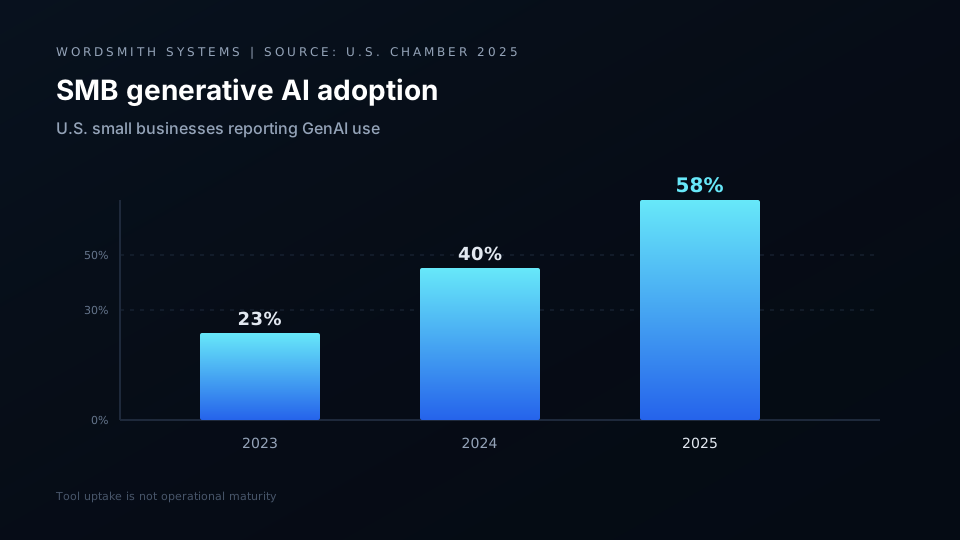
That is tool uptake. It is not operational maturity.
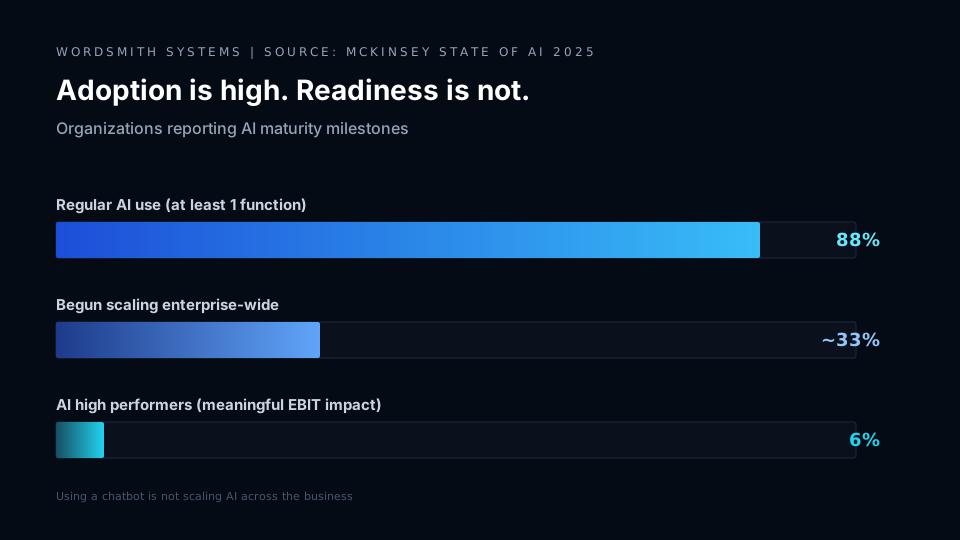
McKinsey's State of AI survey (2025) paints the same picture at a different altitude: 88% of organizations report regular AI use in at least one function, but only about one-third have begun scaling AI enterprise-wide. Among firms under $100 million in revenue, only 29% have reached scaling — versus nearly half of firms over $5 billion. Roughly 6% qualify as "AI high performers" with meaningful EBIT impact.
Salesforce's 2024 Small & Medium Business Trends Report found 75% of SMBs investing in AI, with growing companies 1.8× more likely to invest than declining peers. The same research is blunt about the prerequisite: 85% of SMB IT pros say AI's outputs are only as good as its data inputs, and two-thirds of SMBs plan to increase data-management investment.
Using a chatbot is cheap. Making the business AI-readable is the work.
Why AI projects die: data, not models
When GenAI initiatives fail, the post-mortems rarely blame the model.
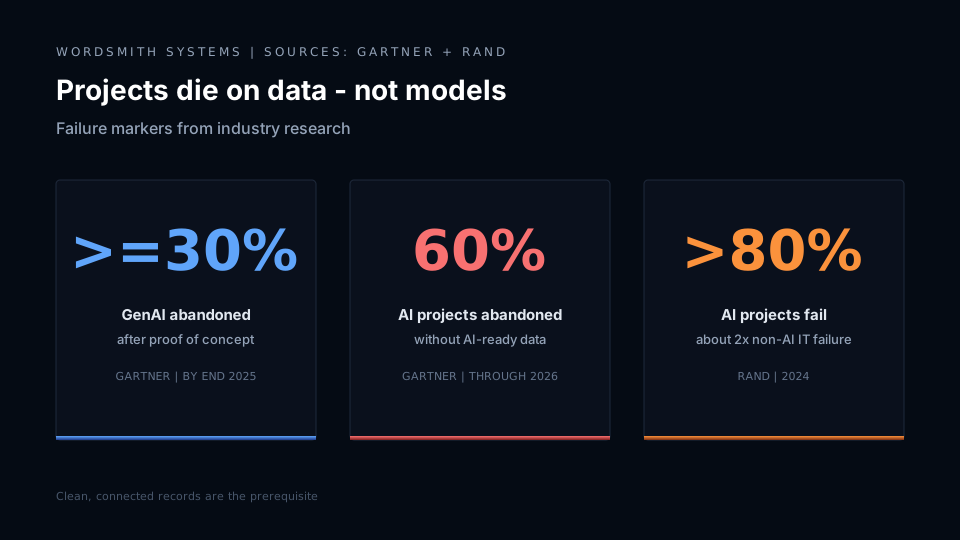
Gartner predicted that at least 30% of generative AI projects would be abandoned after proof of concept by the end of 2025 — driven by poor data quality, inadequate risk controls, escalating costs, or unclear business value. In February 2025, Gartner went further: through 2026, organizations will abandon 60% of AI projects unsupported by AI-ready data. Sixty-three percent of organizations do not have — or are unsure they have — the right data-management practices for AI.
RAND's 2024 research report on AI project failure is even more direct. By some estimates, more than 80% of AI projects fail — roughly twice the failure rate of non-AI IT projects. Thirty of fifty expert interviewees cited persistent data-quality problems. One put it plainly: "80% of AI is the dirty work of data engineering."
IBM's Institute for Business Value found only 25% of AI initiatives delivered expected ROI, and only 16% scaled enterprise-wide. Half of CEOs say recent investments left them with disconnected, piecemeal technology. Only 29% of tech leaders strongly agree their enterprise data meets the quality, accessibility, and security standards needed to scale generative AI.
Informatica's CDO Insights 2025 survey found 67% of organizations unable to move even half of GenAI pilots into production, 43% citing data quality or readiness as a top obstacle, and 97% struggling to demonstrate GenAI business value. S&P Global Market Intelligence reporting (via CIO Dive) found 42% of companies abandoned most AI initiatives in 2025 — up from 17% in 2024 — with the average organization scrapping 46% of AI proofs of concept before production.
The pattern is consistent: pilots look promising in a slide deck. Production needs clean, connected records. Most stacks don't have them.
The real small-business stack: sprawl and spreadsheets
Independent operators rarely have a "data platform." They have a storefront, a bank export, an inbox, a shared Google Sheet, and three SaaS tools that don't talk to each other.
Okta's Businesses at Work 2025 report found the average number of apps per customer hit 101 — up 9% year over year, and the first time the average crossed 100. Even in the 2024 edition, companies with 2,000 or fewer employees averaged 72 apps.
Seventy-two systems is not an operations stack. It is a scavenger hunt with a login screen.
Deloitte Access Economics (commissioned by Amazon Australia, November 2025) surveyed more than 1,000 Australian SMBs and found roughly two-thirds using AI — but only 5% "fully enabled." More than 40% sit at the most basic maturity level. Barriers explicitly include unsuitable business systems and data. Moving from basic to intermediate maturity was linked to roughly 45% profit uplift; intermediate to fully enabled, roughly 111%. Tool access was not the differentiator. Maturity was.
Salesforce's SMB research makes the same cut: growing SMBs are far more likely to run an integrated tech suite (about 66% vs 32% for declining peers). Winners couple AI with systems that share a source of truth. Everyone else asks a model questions it cannot verify.
What "not ready" looks like on a Tuesday
A Visalia maker asks: "What was my margin last month?"
The honest answer, with today's tools, is: "It depends which spreadsheet you believe."
Orders live in Shopify. Shipping lives in a CSV. Payments live in a bank export. Returns live in email. Inventory lives in someone's head until Sunday night.
A general model knows what a purchase order is. It does not know which of your customers is on net-30, that a flagged order means a bad address, or that last month's "revenue" figure double-counted gift cards. That context has to be built — typed columns, relationships, a dedicated database — not prompted.
This is why WordSmith refuses standalone AI consulting for businesses without an operational layer. We will not sell confident answers that are wrong. The model has nothing real to read.
What readiness actually requires
Before AI is worth paying for, a business needs four things:
- Structured records — orders, customers, inventory, messages, and money in typed tables, not PDFs and chat threads.
- A single source of truth — one isolated database per business, not seventeen SaaS exports reconciled by hand.
- Operational context — your statuses, your workflows, your exceptions, encoded where the AI can see them.
- Someone who owns the engine — updates, security, and schema changes as a managed job, not a weekend project.
That sequence is deliberate: audit the workflow, build the foundation, then put intelligence on top. AI is the ceiling of the offering. It is not the floor.
A baseline AI capability — plain-language questions against live data, a monthly health summary — only works once the foundation exists. Deeper capability (cross-module intelligence, Phase 3 automation) is an add-on for clients who already run on that stack. It is never sold alone.
The uncomfortable conclusion
Most small businesses are not ready for AI.
Not because owners are behind. Not because models aren't powerful enough. Because the operational infrastructure — the boring, unglamorous work of putting the business into structured systems — was skipped in the rush to demo a chatbot.
The market will keep selling the demo. The winners will build the foundation first.
If your orders, messages, and money still live in five places, the honest move is not another AI subscription. It is a systems audit: map how work actually moves, identify what has to become structured, and only then decide where intelligence earns its keep.
We do that free. No pitch. No pressure. No obligation.
Book a systems audit → Read how we put AI on the Launchpad →
Sources
-
McKinsey & Company — The State of AI: Global Survey 2025 https://www.mckinsey.com/capabilities/quantumblack/our-insights/the-state-of-ai Stats used: 88% regular AI use; ~1/3 scaling; 29% of <$100M firms scaling vs ~half of >$5B; ~6% high performers.
-
U.S. Chamber of Commerce (C_TEC) — Empowering Small Business, 4th ed., Aug 2025 https://www.uschamber.com/assets/documents/20251621-CTEC-Empowering-Small-Business-Report-2025-v1-r10-Digital-FINAL.pdf Stats used: 58% GenAI use (40% in 2024, 23% in 2023); 96% plan emerging tech incl. AI; 55% of GenAI users ≤1 year.
-
Salesforce — Small & Medium Business Trends Report, 6th Edition (Dec 2024) / SMB AI Trends 2025 news https://www.salesforce.com/en-us/wp-content/uploads/sites/4/documents/resources/smb-trends-report-6th-edition_Salesforce.pdf https://www.salesforce.com/news/stories/smbs-ai-trends-2025/ Stats used: 75% investing in AI; 1.8× investment gap growing vs declining; 85% "outputs only as good as data"; 66% plan more data-management spend; integrated suite ~66% vs ~32%.
-
Okta — Businesses at Work 2025 (and 2024 companion) https://www.okta.com/en-gb/newsroom/articles/businesses-at-work-2025/ https://www.okta.com/sites/default/files/2024-04/Okta-2024_Businesses_at_Work.pdf Stats used: avg 101 apps (+9% YoY); 2024: ≤2,000 employees avg 72 apps.
-
Gartner — GenAI projects abandoned after PoC (Jul 29, 2024) https://www.gartner.com/en/newsroom/press-releases/2024-07-29-gartner-predicts-30-percent-of-generative-ai-projects-will-be-abandoned-after-proof-of-concept-by-end-of-2025 Stats used: ≥30% GenAI projects abandoned after PoC by end of 2025 (data quality, cost, unclear value).
-
Gartner — Lack of AI-Ready Data Puts AI Projects at Risk (Feb 26, 2025) https://www.gartner.com/en/newsroom/press-releases/2025-02-26-lack-of-ai-ready-data-puts-ai-projects-at-risk Stats used: 60% of AI projects unsupported by AI-ready data abandoned through 2026; 63% lack / unsure of data-mgmt practices for AI.
-
RAND Corporation — The Root Causes of Failure for Artificial Intelligence Projects (2024, RRA2680-1) https://www.rand.org/pubs/research_reports/RRA2680-1.html Stats used: >80% AI project failure (≈2× non-AI IT); 30/50 experts cite data quality; "80% of AI is data engineering."
-
IBM Institute for Business Value — 2025 CEO Study (+ AI-ready data findings) https://newsroom.ibm.com/2025-05-06-ibm-study-ceos-double-down-on-ai-while-navigating-enterprise-hurdles https://www.ibm.com/think/topics/ai-ready-data Stats used: 25% AI initiatives hit expected ROI; 16% scaled enterprise-wide; 50% CEOs cite disconnected tech; 29% tech leaders strongly agree data is ready to scale gen AI.
-
Deloitte Access Economics / Amazon Australia — The AI Edge for Small Business (Nov 25, 2025) https://www.deloitte.com/au/en/about/press-room/ai-edge-small-business-increased-smb-ai-adoption-can-add-44-billion-australias-economy-251125.html Stats used: ~2/3 SMBs use AI; 5% fully enabled; >40% basic maturity; ~45% / ~111% profit uplift across maturity steps; systems/data as barriers.
-
Informatica — CDO Insights 2025; S&P Global Market Intelligence (via CIO Dive) https://www.informatica.com/campaigns/cdo-insights-2025/assets/resources/cdo_insights_2025_PDF.pdf https://www.ciodive.com/news/AI-project-fail-data-SPGlobal/742590/ Stats used: 67% can't move half of GenAI pilots to production; 43% cite data readiness; 97% struggle to show GenAI value; 42% abandoned most AI initiatives in 2025 (vs 17% in 2024); avg 46% of PoCs scrapped before production.