The WordSmith Model: Why We Are a Managed Service, Not an Agency
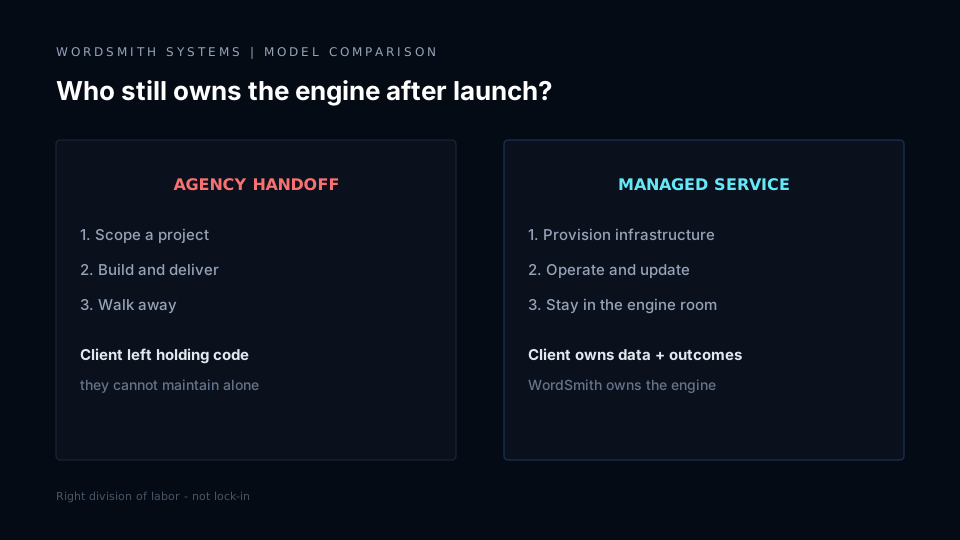
Most digital agencies run the same playbook: scope a project, build a deliverable, hand over a ZIP or a CMS login, and disappear.
The client is left holding something they do not fully understand, cannot safely change, and that quietly decays the moment a dependency updates or a workflow shifts.
WordSmith does not operate that way.
We are a managed-service platform. We design, build, and permanently operate the operational infrastructure behind independent businesses. You own your data and your business outcomes. We own the engine.
That is not a slogan. It is the division of labor that keeps systems alive.
The agency problem is not bad code. It is orphaned code.
Plenty of agencies ship clean work. The failure mode shows up later.
- A shipping rule changes. Nobody knows which table or Edge Function owns it.
- A payment provider rotates keys. The weekend "handoff doc" is already stale.
- Staff turnover means institutional memory walks out with the last contractor.
- The next "small change" becomes a new SOW because the original team is gone.
For an independent operator in Visalia or anywhere in the Central Valley, that pattern is expensive. You did not hire a partner. You rented a sprint.
What managed service actually means here
On the Launchpad stack, every client gets:
- An isolated database — one Supabase project per business, under WordSmith org control. No shared tenancy. No cross-client data bleed.
- Modules that are real systems — not feature checkboxes. Order queues, messages, analytics, catalog tools — each with schema, RLS, and an operator UI.
- Ongoing operation — updates, schema changes, security, and platform improvements land without asking the client to become a part-time DevOps team.
- A relationship, not a ticket dump — strategy check-ins, clear ownership when something breaks, and a single place where the business actually runs.
Cadence Creatures is our in-house battle-test of that model: orders, fulfillment, inventory, messaging, and analytics on one stack — not seventeen exports reconciled by hand.
Pharoahs Car Club of Visalia is the first external paying Launchpad client: events, gallery, member surfaces, and admin tools managed as infrastructure, not a one-time website project.
"Isn't that lock-in?"
Fair question.
Lock-in is when you cannot leave and cannot understand what you paid for.
WordSmith's model is the opposite split: you own the records and the outcomes; we retain root control of the infrastructure because that is the only way to keep RLS, backups, provisioning, and module upgrades coherent.
You are the expert in your business. We are the experts in building and maintaining the systems that run it. Pretending every shop owner should also be a platform engineer is how agency handoffs fail.
What you get that a handoff never includes
- Platform updates that do not require a new agency engagement
- Security and schema work treated as operations, not billable surprises
- Modules that share a source of truth instead of five SaaS logins
- A path to operational AI only after the data layer exists — never sold as a standalone demo
If your current stack is a website plus a spreadsheet plus an inbox, an agency rebuild of the website alone will not fix the operating system of the business.
The uncomfortable line
A deliverable is a moment in time. An operating system is a relationship.
Independent businesses do not need another ZIP file. They need someone who stays in the engine room while they stay on the floor.
Book a systems audit →
See how the Launchpad is structured →